The world of Pokémon is ever-expanding, a vibrant tapestry woven with creatures of all shapes, sizes, and elemental types. For trainers new and old, keeping track of every single Pokémon can feel like a monumental task. As of early 2026, the official National Pokédex boasts an impressive 1,025 distinct Pokémon species, a testament to decades of imaginative creation. But this number only scratches the surface when you consider all the fascinating forms and variations that exist.
From the very first Bulbasaur to the latest additions in Paldea, each new generation of games brings a fresh wave of excitement and new friends to discover. Whether you're a seasoned Professor Oak in the making or just starting your journey, understanding how these creatures are counted and categorized by generation is key to appreciating the vastness of the Pokémon universe.
Counting Every Creature: What Defines a "Pokémon" Total?
When we talk about "how many Pokémon there are," the answer can be surprisingly nuanced. The most commonly cited and official count refers to 1,025 core species, each assigned a unique number in the National Pokédex. This count primarily focuses on new, distinct species and typically excludes temporary battle forms or most regional variants that aren't considered entirely new species within the main Pokédex numbering system.
However, for those who want the most comprehensive picture, the total number of Pokémon — including all distinct forms like regional variants, Mega Evolutions, and Gigantamax forms — swells to an astounding 1,164. This more inclusive figure truly showcases the incredible diversity Pokémon designers have brought to life. If you're keen to Understand Pokémon generations and counting, it's essential to grasp these distinctions.
These additional forms add layers of strategy and visual flair to the games:
- 59 Regional Forms: These Pokémon, like Alolan Vulpix or Hisuian Sneasel, have adapted to different environments, resulting in unique typings, appearances, and abilities. Some are even considered new species in the National Pokédex if their changes are significant enough (e.g., Hisuian forms).
- 96 Mega Evolutions: Introduced to temporarily transform certain Pokémon in battle, Mega Evolutions bring radical changes to appearance and power. This count includes exciting additions from 2025's Pokémon Legends Z-A and its Mega Dimension DLC, showing that even older mechanics can get fresh updates.
- 32 Gigantamax Forms: Exclusive to the Galar region, these forms see Pokémon grow to colossal sizes with unique G-Max moves during battles.
- Other Alternate Forms: Special cases like Partner Pikachu and Partner Eevee from Pokémon Let's Go! also contribute to the grand total of unique appearances.
The Generational Journey: Tracking New Pokémon Through the Ages
Each Pokémon generation is typically tied to a new region, a fresh storyline, and, most importantly, a batch of entirely new Pokémon for trainers to discover. Over nine generations, the number of new creatures introduced has varied, but the excitement has always been constant. On average, each generation adds roughly 70 to 160 new species to the ever-growing roster. Let's embark on a journey through each era to see how the Pokémon world has expanded.
The Dawn of Discovery: Generations 1 & 2 (Kanto & Johto)
The adventure began in Kanto, capturing the hearts of millions and sparking a global phenomenon. Just a few years later, the Johto region expanded that world even further, introducing new evolutions and a deeper lore.
Generation 1 (Kanto)
- Released: 1996
- Games: Red, Blue, Yellow
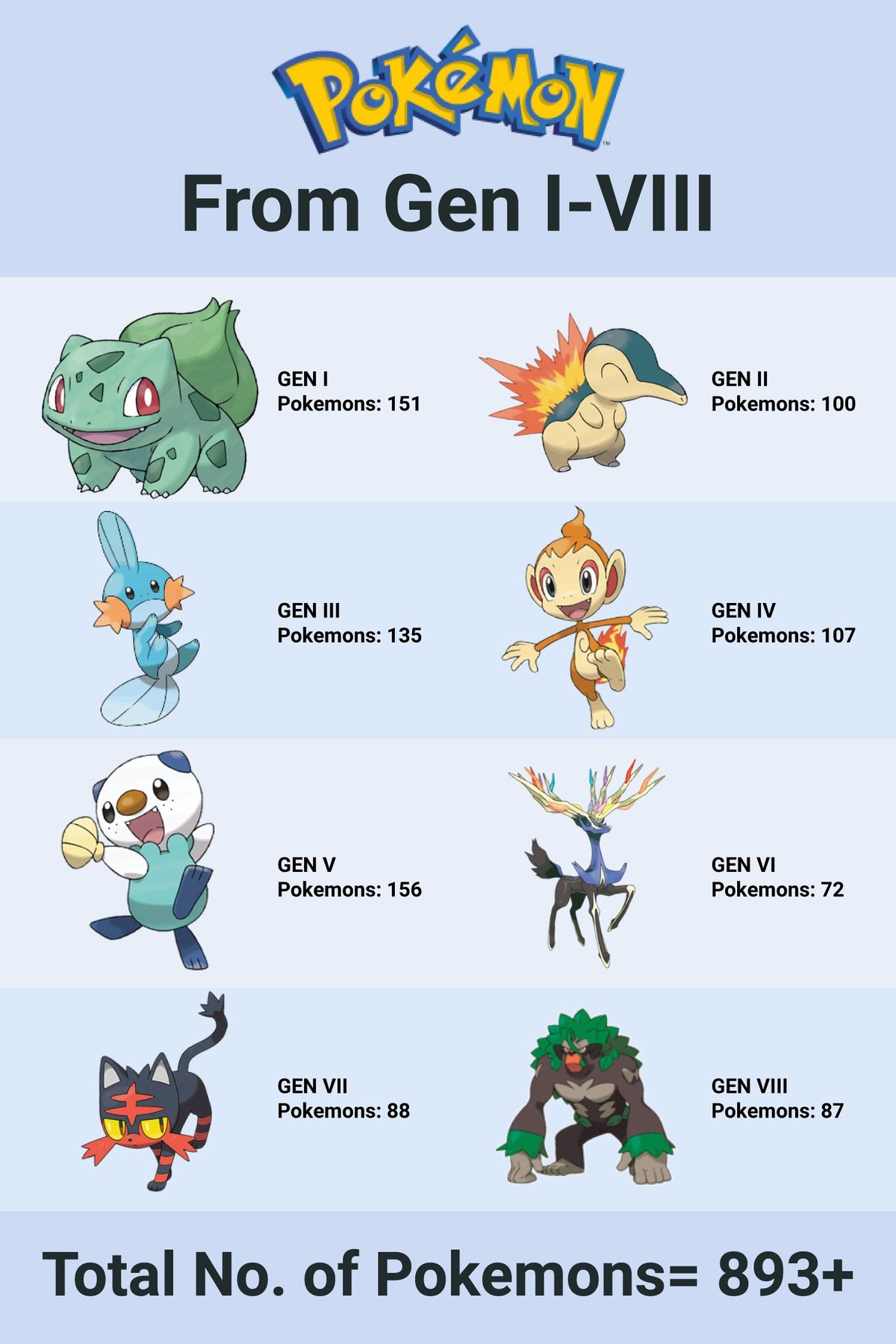
- New Pokémon Introduced: 151
- First Pokémon: Bulbasaur (#001)
- Last Pokémon: Mewtwo (#151)
- Key Features: Laid the foundation for the entire franchise, introduced the original trio of Legendary Birds (Articuno, Zapdos, Moltres) and the elusive Mewtwo.
Generation 2 (Johto) - Released: 1999
- Games: Gold, Silver
- New Pokémon Introduced: 100
- First Pokémon: Chikorita (#152)
- Last Pokémon: Celebi (#251)
- Key Features: Introduced Steel and Dark types, added baby Pokémon and new evolutions for Kanto creatures like Crobat and Pichu. Ho-Oh and Lugia graced this generation as majestic Legendary Pokémon.
To truly appreciate the foundation of the Pokémon universe, Generation 1 & 2: Kanto details the original 251 species and their impact.
Expanding Horizons: Generations 3 & 4 (Hoenn & Sinnoh)
Moving into the 2000s, Pokémon embraced more complex narratives and introduced unique environmental themes in Hoenn, followed by the mythology-rich Sinnoh region.
Generation 3 (Hoenn)
- Released: 2002
- Games: Ruby, Sapphire, Emerald
- New Pokémon Introduced: 135
- First Pokémon: Treecko (#252)
- Last Pokémon: Deoxys (#386)
- Key Features: Introduced Abilities and Natures, along with the powerful weather trio of Groudon, Kyogre, and Rayquaza as major Legendary figures.
Generation 4 (Sinnoh) - Released: 2006
- Games: Diamond, Pearl, Platinum, HeartGold, SoulSilver
- New Pokémon Introduced: 107
- First Pokémon: Turtwig (#387)
- Last Pokémon: Arceus (#493)
- Key Features: Added the physical/special split for moves, brought forth many new evolutions for older Pokémon (e.g., Magnezone, Leafeon), and introduced the god-like Pokémon Arceus.
For a deeper dive into the creatures from these regions, you can Explore Hoenn & Sinnoh totals View.
Record Breakers and New Dimensions: Generations 5 & 6 (Unova & Kalos)
These generations pushed boundaries, from the largest single generation of new Pokémon in Unova to the franchise's first foray into full 3D graphics in Kalos.
Generation 5 (Unova)
- Released: 2010
- Games: Black, White
- New Pokémon Introduced: 156 – The most of any generation!
- First Pokémon: Victini (#494)
- Last Pokémon: Genesect (#649)
- Key Features: Focused heavily on its own roster, with few older Pokémon available before the post-game. Introduced the Forces of Nature and the legendary dragons Reshiram, Zekrom, and Kyurem.
Generation 6 (Kalos) - Released: 2013
- Games: X, Y
- New Pokémon Introduced: 72 – The lowest number in any generation.
- First Pokémon: Chespin (#650)
- Last Pokémon: Volcanion (#721)
- Key Features: Ushered in 3D graphics for mainline games, introduced the Fairy type, and brought the revolutionary Mega Evolutions. Xerneas, Yveltal, and Zygarde were the flagship Legendary Pokémon.
To get the full rundown on these groundbreaking generations, you'll want to Unova & Kalos Pokémon Totals Explore.
Regional Forms and Ancient Histories: Generations 7 & 8 (Alola & Galar/Hisui)
Innovations continued with the introduction of regional forms and extra-dimensional creatures, followed by the dynamic Galar region and a journey into the past with Hisui.
Generation 7 (Alola)
- Released: 2016
- Games: Sun, Moon, Ultra Sun, Ultra Moon, Let's Go Eevee/Pikachu
- New Pokémon Introduced: 88
- First Pokémon: Rowlet (#722)
- Last Pokémon: Melmetal (#809)
- Key Features: Introduced Regional Forms (like Alolan Vulpix) and the mysterious Ultra Beasts, which are extradimensional Pokémon. This generation saw a host of Legendary Pokémon, including the Tapu Guardians and the cosmic duo Solgaleo and Lunala.
Generation 8 (Galar and Hisui) - Released: 2019
- Games: Sword, Shield (and DLCs), Brilliant Diamond, Shining Pearl, Legends: Arceus
- New Pokémon Introduced: 96 (89 from Sword/Shield, 7 from Legends: Arceus)
- First Pokémon: Grookey (#810)
- Last Pokémon: Enamorus (#905)
- Key Features: Introduced Gigantamax forms and marked the first mainline generation where not all previous Pokémon were importable. Legends: Arceus brought new Hisuian forms and evolutions that were considered entirely new species in the National Pokédex, expanding the lore of Sinnoh's past.
Curious about the creatures from these innovative regions? Explore Alola & Galar Pokémon totals.
Stepping into the Future: Generation 9 (Paldea)
The most recent main series games took us to the vast open world of Paldea, continuing the tradition of introducing exciting new mechanics and Pokémon.
Generation 9 (Paldea)
- Released: 2022
- Games: Scarlet, Violet (and DLCs)
- New Pokémon Introduced: 120 – The most since Generation 5!
- First Pokémon: Sprigatito (#906)
- Last Pokémon: Pecharunt (#1025)
- Key Features: Introduced the Terastallization phenomenon, Paradox Pokémon (ancient or futuristic versions of existing species), and a new roster of Legendary Pokémon, including the rideable Koraidon and Miraidon. This generation added more new Pokémon than any since the Unova region.
Beyond the Generations: Legendary Power and Elemental Forces
Beyond the individual generation counts, certain categories of Pokémon stand out for their rarity and significance. Out of the 1,025 core species, a remarkable 71 are Legendary Pokémon, creatures of immense power and often central to their region's myths and legends. Additionally, 11 Ultra Beasts, all introduced in Generation 7, represent a unique class of extradimensional Pokémon that defy typical classifications.
The foundation of every Pokémon's identity lies in its type. As of 2026, there are 18 official Pokémon types: Normal, Fire, Water, Grass, Electric, Ice, Fighting, Poison, Ground, Flying, Psychic, Bug, Rock, Ghost, Dark, Dragon, Steel, and Fairy. These types dictate strengths, weaknesses, and move sets, adding a deep layer of strategy to battles. Some Pokémon even boast dual types, and many undergo type changes as they evolve, keeping trainers on their toes.
What's Next for the World of Pokémon?
The Pokémon universe is constantly evolving, with new discoveries always on the horizon. With nine generations firmly established and a staggering 1,025 core species to date, fans are already eagerly anticipating what comes next. Given the typical release cadence, a flagship announcement for the 10th generation mainline game, likely featuring an entirely new region and a fresh batch of Pokémon, is eagerly awaited. The journey of catching 'em all is far from over!